Clear aligners or braces? A comparison for adults
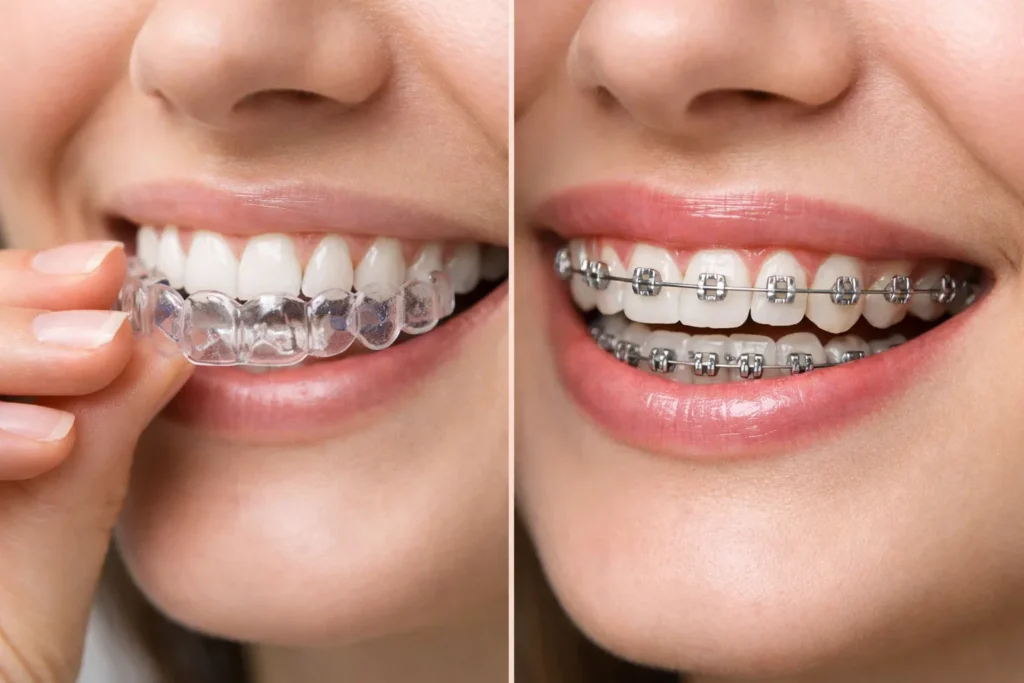
Dental crowding, gaps, or occlusion problems are not exclusive to childhood and adolescence. Nowadays, many adults seek orthodontic treatment for a straighter and healthier *smile*.
However, one of the most frequently asked questions by adult patients is:
Is a clear aligner better, or traditional braces?
There is no single answer to this question. The most suitable treatment method may vary depending on the current position of the teeth, jaw structure, occlusion problems, and the patient’s lifestyle.
Here is a comparison of clear aligners and braces for adults.
What is a Clear Aligner?
Clear aligner treatment is an orthodontic method that uses custom-made transparent appliances to gradually move the teeth into planned positions.
The aligners are changed at specific intervals to ensure controlled movement of the teeth.
One of the most significant advantages is that they are less noticeable compared to traditional metal brackets when viewed from the outside.
What is Braces Treatment?
In braces treatment, controlled force is applied through brackets and wires placed on the teeth.
This method, which can be applied with metal or aesthetic bracket options, is one of the effective methods used in orthodontic treatment for many years.
It is particularly among the important treatment options that a physician may prefer for comprehensive orthodontic problems.
Comparison of Clear Aligners and Braces
1. Aesthetic Appearance
One of the most important aspects that adult patients consider when choosing a treatment is aesthetic appearance.
Clear aligners are less noticeable in daily life due to their transparent structure.
Braces, especially when metal brackets are used, are more visible. However, there are now tooth-colored or more aesthetic bracket options available.
For adults prioritizing aesthetics, clear aligners may be an advantageous option.
2. Daily Use Comfort
One of the most important features of clear aligners is that they are removable.
Aligners can be taken out while eating or brushing teeth. This can facilitate daily oral hygiene.
Braces, on the other hand, are used fixedly. Careful cleaning around the brackets is required throughout the treatment.
However, for clear aligners to be successful, it is crucial to adhere regularly to the recommended usage duration by the physician.
3. Eating Habits
In braces treatment, certain hard or sticky foods can damage the brackets.
In clear aligner treatment, since the aligners are removed during meals, there is more flexibility regarding diet.
However, after eating, it is necessary to clean the teeth and reinsert the aligners correctly.
4. Oral and Dental Care
For individuals using braces, cleaning around the brackets and wires may require more care.
In clear aligners, since the aligners can be removed, brushing and cleaning between the teeth can be performed more easily.
Regular oral care is crucial for the success of both treatment methods.
5. Treatment Duration
The question “Are clear aligners faster?” is frequently asked.
However, the treatment duration is not solely dependent on the method used.
Factors affecting the duration include;
- The degree of crowding in the teeth
- Occlusion problems
- Jaw structure
- Compliance with the treatment plan
- Control processes
In some cases, clear aligner treatment can provide very effective and quick results, while in some complex cases, fixed orthodontic treatments may be more suitable.
6. Patient Compliance
Patient compliance is an important factor in the success of clear aligner treatment.
Not using the aligners regularly for the recommended duration can affect the treatment plan and overall treatment duration.
In braces, since the system is fixed, the patient does not have the responsibility to put on and take off the appliance.
Therefore, when choosing a treatment, the patient’s lifestyle and ability to comply with the treatment should also be evaluated.
Which is More Suitable for Adults?
When choosing between clear aligners and braces, it is not correct to decide solely based on aesthetic appearance.
Clear aligners are particularly suitable for;
- Those who want a less visible treatment
- Those with aesthetic concerns in their work and social life
- Those who prefer a removable treatment alternative
- Those who want to maintain oral hygiene more comfortably
Braces, on the other hand, may be preferred for;
- More comprehensive orthodontic problems
- When a fixed treatment system is preferred
- When more controlled force application is needed according to the clinician’s evaluation
Orthodontic Examination is Important Before Starting Treatment
Every *smile* and every orthodontic problem is different.
Therefore, general comparisons made on the internet can provide ideas, but an orthodontic examination is necessary to determine which method is suitable for you.
After a detailed evaluation, the current position of the teeth, occlusion relationship, and treatment goals can be determined, allowing for the planning of the most suitable method for you.
Conclusion: The Best Method is the One Suitable for You
While clear aligners offer an attractive option for many adults in terms of aesthetics and daily usability, traditional orthodontic treatment may be a more suitable solution in some cases.
What is important is to find the correct answer to the question “which is better?” rather than “which treatment is more suitable for my needs?”
For a healthy, balanced, and aesthetic *smile*, it is best to make your treatment choice after a detailed evaluation by a qualified dentist.
Leave a comment
Share your questions and experiences. Comments are published after review by the dentist.